
Inside the Design of TLX's Modular Coolant Valves
Automotive manufacturers are facing new challenges in the design of thermal management systems, and each manufacturer tends to take its own approach to solving those challenges, especially when developing systems for electric vehicles. The migration away from using wax motor thermostats toward electrically controlled valves to manage the flow of coolant has created a demand for new valving solutions.
Dominic Petri, a design engineer at TLX Technologies, says, “The company had received multiple requests for valving solutions that were similar but not the same. Most of the requests also had relatively low production volumes, so TLX decided to create a solution that could broadly cover these needs and leverage a common tooling set to keep the cost of buy-in to a minimum.”
With this in mind, TLX developed a family of modular valves for the industry. This family of modular valve products currently includes three-way and four-way switching valves with port sizes up to 25.4mm.
“Changing the inserts in the mold tool allows us to change the port sizes in a cost-effective way,” notes Petri. Regardless of port size, the drive system and diverter remain unchanged.
Features like these are at the heart of what makes this product family modular. “This modularity means that changing the valve specifications is a matter of tooling up one new component rather than an entire valve concept,” says Petri. “Data from prior durability and performance testing can also be leveraged to reduce project risk for our customers.”
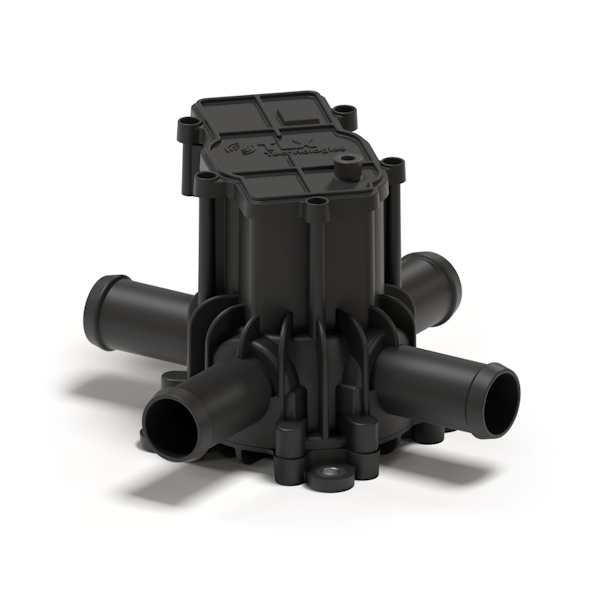
The modular valve product family can also meet the power and control requirements of different thermal management systems. These valves can support 12V DC and 24V DC operation and PWM or LIN control strategies. Mike Osvatic, engineering manager at TLX Technologies, states, “The difference between PWM and LIN is feedback. PWM gives one general fault error with no details. LIN gives specific fault codes for over-current, motor stall, motor stall lockout, over-voltage, under-voltage and overtemperature. TLX is considering CAN for communications in future revisions.”
A key consideration during development was designing valves that help maximize the energy efficiency of a vehicle’s thermal management system. This was achieved in two ways. First, the valves do not require constant power to maintain a commanded position. Second, they feature an efficient flow path. Osvatic says, “These valves minimize pressure drop through the use of smooth transitions and gradual turns through the fluid flow path.” Petri observes, “This is important because it allows a pump to handle fluid circulation with less energy consumption. Whether an electric, hybrid or ICE vehicle, reducing the energy consumption of different vehicle systems results in better mileage or range.”
Designing the valves to minimize cross-flow leakage was another important consideration. Keeping the bypass leakage low helps make the cooling system more predictable, controllable and efficient. Osvatic notes, “Leakage contributes to thermal losses, and these losses make for a less efficient cooling system, which could drive the need for larger coolers, heat exchangers or pumps.”
As thermal management systems continue to evolve, new valve specifications are likely to follow, and TLX’s family of modular valves is adaptable to even more configurations to meet those potential demands. Osvatic says, “A three-way proportional valve, a two-way switching valve and a two-way proportional valve could also be added to the family.”
This article was originally published by Automotive Powertrain Technology International in September 2024

